What is a Programming Language?
A programming language is a set of words and rules humans use to write instructions that a computer can follow.
Think of it like this
Computers only truly understand patterns of 1s and 0s - far too fiddly for humans to write directly. A programming language is like a translator's phrasebook: you write instructions in something close to English, with strict grammar, and a translator program converts it into the 1s and 0s the machine actually runs.
What's happening
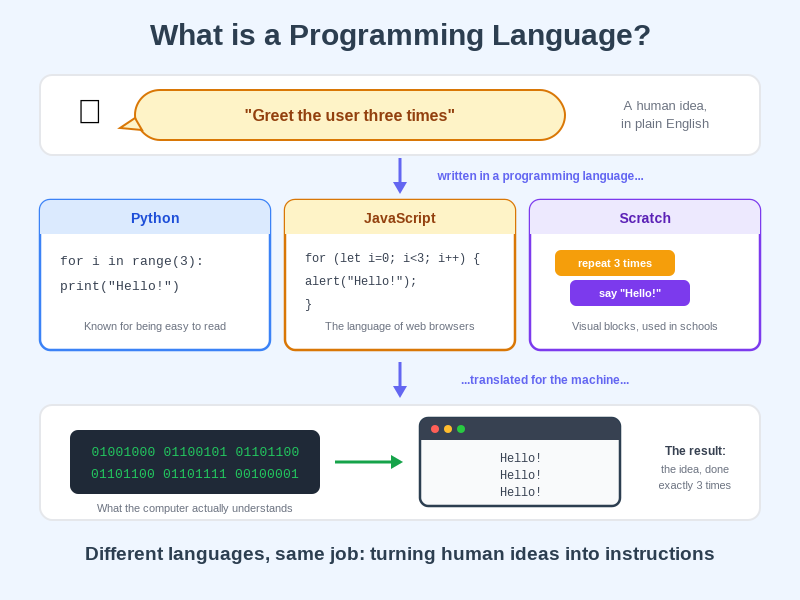
Summary
A programming language lets humans write precise instructions in a readable form, which get translated into the binary code a computer can execute.
A Closer Look
There are hundreds of programming languages, and they exist for the same reason there are hundreds of kitchen knives: different jobs. JavaScript runs in web browsers, Python is popular for data and AI because it reads almost like English, and languages like C++ are used where speed matters most, such as games. Despite the different vocabulary, they all express the same core ideas - do this, repeat that, decide between options.
Strictly speaking, HTML and CSS are not programming languages - they describe what a page is and how it looks, but they can't make decisions or repeat steps. That's why JavaScript was added to the trio: it's the one that can actually compute.
Languages also differ in when the translation into 1s and 0s happens. In a compiled language, such as C++ or Rust, a program called a compiler translates the whole thing in one go before it runs, producing a finished file that runs quickly. In an interpreted language, such as Python, a program called an interpreter reads and carries out the instructions as it goes, which makes it quicker to try out ideas but usually a little slower to run. In practice the line is blurry, and modern browsers use clever tricks to speed JavaScript up while it runs. Languages have been evolving since the 1950s, when early ones like FORTRAN first let scientists write formulas instead of raw machine code.
Common Misconceptions
- You don't need to be good at maths - most programming is closer to writing very precise instructions than solving equations.
- There is no single "best" language - the right one depends on the job, and the concepts you learn in one carry over to all the others.
- Programmers don't memorise everything - even professionals constantly look up syntax; what matters is understanding the logic, not reciting the vocabulary.
Frequently asked questions
Which programming language should a beginner learn first?
There is no wrong answer, but two are common choices. Python is popular because its code is short and reads almost like English, so you can focus on ideas rather than punctuation. JavaScript is a good pick if you're interested in websites, because it runs in every browser with nothing to install. Children often start with Scratch, where you snap blocks together instead of typing. The skills you learn carry over to whichever language comes next.
How long does it take to learn a programming language?
Writing your first small working program can take an afternoon. Becoming comfortable enough to build simple projects on your own usually takes a few months of regular practice. Becoming really skilled takes years, but that's true of any craft, and even experienced programmers keep learning. Short, frequent practice on small projects you care about tends to work better than long sessions spent only reading or watching tutorials.
Why can't we just program computers in plain English?
Computers need instructions that are exact and unambiguous, and everyday English is full of words with several meanings and sentences that depend on context. Programming languages solve this with strict rules, so every instruction means exactly one thing. AI chatbots can now turn plain-English requests into code, but that code is still written in a programming language underneath, and someone needs to check it really does what was intended.
How it connects
Programming languages are how every other topic on this site gets built:
Try it yourself
Open your browser's console (press F12, then click "Console") and type alert("Hello!") and press Enter. You just wrote and ran a line of JavaScript - a real programming language instruction that your browser translated and executed instantly.