What is the Cloud?
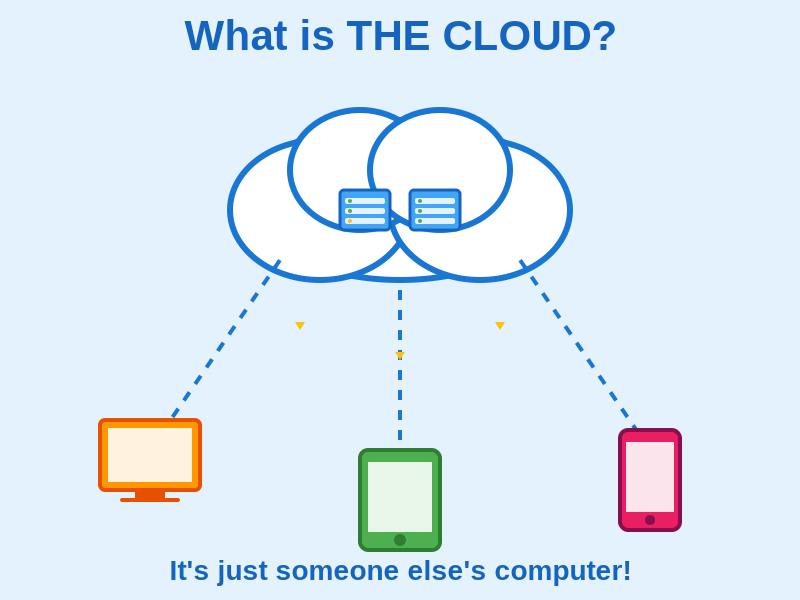
"The cloud" just means using other people's computers on the internet instead of your own.
Think of it like this
It's like renting a storage unit instead of cramming everything into your bedroom. Someone else owns the building, keeps it secure, and handles the maintenance - you pay for the space you use and visit whenever you need your things. Need more room? Rent a bigger unit, instead of building an extension.
What's happening
Summary
The cloud is computing you rent instead of own: your files and apps live on someone else's computers in data centres, and you reach them over the internet from any device.
A Closer Look
"The cloud" means storing data and running programs on computers in someone else's data centre, reached over the internet, instead of only on your own device. When you back up photos to iCloud or Google Photos, stream music from Spotify, or write in Google Docs, you're using the cloud. Your files and apps live on powerful servers maintained by the provider, so you can reach them from any device with an internet connection.
For businesses, the big shift is renting instead of buying. Rather than buying and running their own servers, companies rent computing power and storage from providers like Amazon Web Services, Microsoft Azure, and Google Cloud, paying only for what they use. If a website suddenly gets ten times more visitors, it can switch on more servers in minutes, then switch them off again when things calm down. The trade-off is dependence: if the provider has an outage, or your account is locked, everything you keep there can become unreachable at once.
Cloud services are often sorted into three layers, and the jargon is simpler than it sounds. Software as a Service (SaaS) is a finished app you use over the internet, like Gmail or Microsoft 365 - most people only ever touch this layer. Platform as a Service (PaaS) gives developers a ready-made place to run their own code without looking after the machines underneath. Infrastructure as a Service (IaaS) rents out the raw building blocks - virtual computers, storage and networks - to companies that want full control. Behind all three, providers usually keep several copies of your data on different machines, often in different buildings, so a single broken hard drive or power cut doesn't mean your files disappear.
Common Misconceptions
- The cloud isn't magical or wireless - it's real physical computers sitting in large buildings called data centres.
- "Storing something in the cloud" doesn't mean it's safer - it just means it's on someone else's server.
- The cloud isn't one single thing - it's a general term for many different services and providers.
Frequently asked questions
Is my data private in the cloud?
It depends on the provider and the service. Your files are normally protected from other customers and strangers, and the big providers generally encrypt data both while it's stored and while it travels. But the provider itself can often access it, may scan it for illegal content, and can be legally required to hand it over. For extra privacy, some services offer end-to-end encryption, where only you hold the key.
What happens to my files if I stop paying for cloud storage?
Policies vary, so check your provider's terms. Typically you'll be warned first, then lose the ability to upload new files once you're over the free allowance. If an account stays over its limit or unused for a long time, some providers eventually delete the excess content. Before cancelling, download anything you want to keep so you have your own copy.
Can I use the cloud without an internet connection?
Mostly not, because the files and apps live on computers somewhere else. Many services soften this by keeping a copy of chosen files on your device, so you can open and edit them offline, then sync your changes back when you reconnect. It's worth marking anything important as available offline before travelling, or anywhere the signal is unreliable.
How it connects
The cloud is built on top of the same infrastructure as everything else:
Try it yourself
Save a photo to Google Photos or upload a file to Google Drive. You're using the cloud right now - that file is on a server in a data centre, not on your device.